News
White House Authorizes Vetted Private Firms Offensive Cyber Operations Against Foreign Cybercriminals
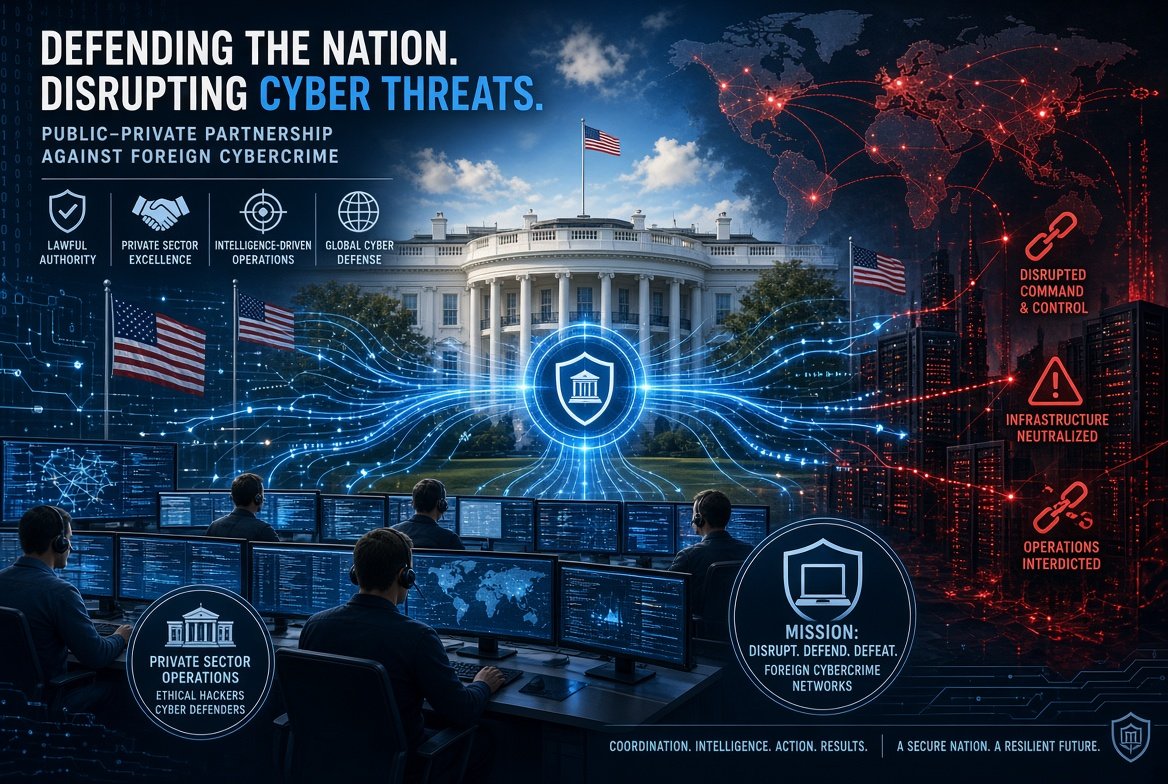
A Landmark Policy Shift in Combating Transnational Cybercrime
On August 12, 2026, a National Security Presidential Memorandum directed the National Coordination Center to establish a formal program enabling rigorously vetted U.S. private companies to conduct cyber surveillance and effects operations against foreign cyber-enabled transnational criminal organizations. This marks the first explicit U.S. government authorization for private-sector offensive cyber activity against non-state actors, conducted strictly under federal direction.
The move responds to escalating threats from ransomware, financial fraud, sextortion, and related schemes. In 2025 alone, American consumers reported more than $20.8 billion in losses to cyber-enabled crime, with sophisticated transnational groups operating beyond traditional U.S. reach.
Strict Guardrails and Operational Framework
Participating firms must undergo rigorous vetting for technical proficiency, proven cyber capabilities, security standards, and reliability. They are required to post a minimum $1 million escrow bond, forfeited upon non-compliance, and enter contractual agreements with the Departments of Justice or Homeland Security.
All operations require dual approval from Program Executive Directors drawn from DOJ and DHS. Activities remain under exclusive federal control and legal authorities, with explicit prohibitions on targeting U.S. persons or systems and bans on actions that could produce “critical outcomes” such as loss of life or armed conflict under international law. Implementation procedures are due within 60 days.
What This Means for the Cybersecurity Industry
This policy transforms commercial offensive capabilities into formal instruments of national power. CISOs and boards now face an environment in which selected private firms become extensions of government operations—creating new partnership opportunities but also potential regulatory scrutiny and reputational exposure.
The framework accelerates a broader trend: the erosion of the long-standing firewall between private defensive cybersecurity and state-directed offensive action. It challenges traditional notions of corporate neutrality in cyberspace while revealing the government’s recognition that scale and speed advantages reside primarily in the private sector.
One additional perspective worth considering: Beyond immediate operational risks, the program may inadvertently reshape the global market for offensive tools. Firms that gain authorization could develop proprietary capabilities later commercialized or exported under different regulatory regimes, creating a dual-use technology ecosystem that other nations may emulate or exploit.
An insight not explicitly covered in the sources is the potential for competitive distortion. Authorized participants may gain privileged threat intelligence through government channels, placing non-participating security vendors at a structural disadvantage in both defensive services and incident response markets.
Balancing Opportunity Against Escalation Risks
While the memorandum emphasizes constitutional compliance and deconfliction across agencies, questions of attribution errors, collateral damage, and diplomatic blowback remain unresolved. Experts have already flagged risks that American personnel could be treated as non-uniformed combatants abroad.
The policy does not authorize unrestricted “hack-back”; every action stays under federal supervision. Still, the introduction of commercial actors into offensive operations injects new variables into an already opaque domain of attribution and retaliation.
The United States has crossed a threshold. Private-sector ingenuity is now formally enlisted as an offensive instrument against cybercriminal networks. Success will hinge on whether rigorous oversight can contain the very escalation dynamics the policy seeks to disrupt. For industry leaders, preparation is no longer optional—it is the new operating baseline.
-- Nick Antonizick
URL Links:
- https://www.whitehouse.gov/presidential-actions/2026/08/expanding-capabilities-to-combat-transnational-cyber-enabled-crime/
- https://techcrunch.com/2026/08/13/in-a-first-us-will-allow-some-private-firms-to-carry-out-cyberattacks/
- https://arstechnica.com/security/2026/08/white-house-recruits-security-firms-to-hack-overseas-cybercriminals/